
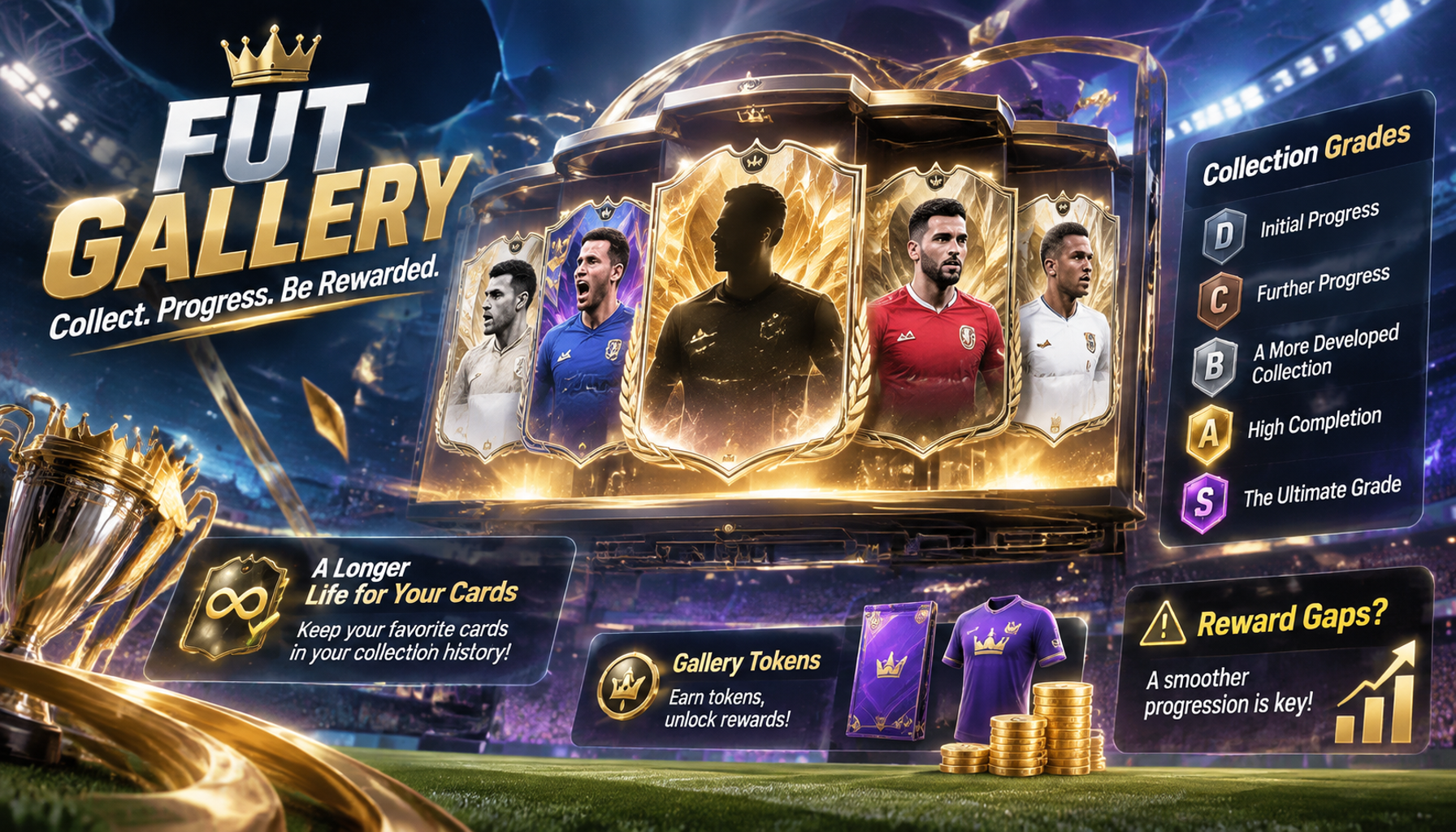
The FUT Gallery introduces a different way to think about player cards in Ultimate Team. Instead of measuring every item only by its usefulness in a starting lineup or its value on the transfer market, the system gives eligible cards a lasting role in a club’s collection history. This changes how players approach squad decisions, especially when managing resources such as FC 27 Coins and deciding which items are worth keeping, selling, or submitting into Squad Building Challenges. The idea adds a new layer to the mode, but its long-term appeal depends on whether collection progress feels rewarding rather than becoming another routine players have to complete.
FUT Gallery Gives Player Cards a Longer Life
One of the most interesting aspects of the Gallery is its separation of collection records from the items currently held in a club. In a traditional Ultimate Team routine, a player card often loses its immediate purpose once it is sold, replaced by a stronger option, or submitted into an SBC. The Gallery changes that relationship by allowing eligible cards to remain part of a player’s collection history even after they leave the club.
This distinction gives certain items a value that extends beyond their performance on the pitch. A card might no longer fit the starting eleven, but its contribution to a collection can still matter. Players who regularly rotate their squads or complete SBCs may find this particularly relevant, since they can make decisions based on both their immediate team requirements and their longer-term collection progress.
There are still rules that determine which items qualify. Loan items are excluded from collection records, while Evolution items are recorded according to their base versions. These details matter because the Gallery is not simply a permanent archive of every card a player has used. It follows specific eligibility conditions, and understanding those conditions can help players avoid unrealistic expectations about which items will count.
The system also introduces a different way to look at club history. A card does not necessarily need to remain in the club for the entire season to have a lasting contribution. That could make squad rotation feel less restrictive, particularly for players who enjoy experimenting with different teams rather than holding on to every useful item.
Collection Grades Add a New Layer to Squad Management
Gallery Sets organize eligible cards into collections based on different requirements. Item Score provides the basic measure of a card’s contribution, while Tags introduce additional criteria connected to characteristics such as league, nation, rarity, and ownership status. These elements determine how much progress an item can provide toward a particular Set.
The grading system gives players a visible indication of how far they have progressed. Rather than treating every collection as a simple checklist, the Gallery uses several levels to distinguish between partial and stronger completion.
| Gallery Grade | Progression Meaning |
|---|---|
| D | Initial collection progress |
| C | Further progress toward completing the Set |
| B | A more developed collection |
| A | High collection completion |
| S | The highest collection grade |
An important detail is that one eligible card can contribute to multiple Sets when it matches their requirements. A player item that fits a particular league, nation, and rarity category may therefore have value in several collection objectives at once. This creates more room for planning, although it also means that players need to understand how the different requirements overlap.
Gallery Tokens and the Gallery Token Store add another layer to the process. Players can earn tokens through collection activity and use them to access available rewards, while Gallery Levels provide a longer progression target. These systems connect card collection with a separate reward structure, giving players reasons to pay attention to items that might otherwise be considered disposable.
The challenge is making those rules easy to understand. If players cannot quickly identify why a card contributes to a Set or how much progress it provides, the system risks feeling more complicated than it needs to be. Clearer explanations of Item Score, Tags, and overlapping collection requirements would make the Gallery easier to use without removing the planning involved.
Reward Gaps Are Raising Questions About Long-Term Progression
The Gallery’s progression structure has also prompted questions about the distance between certain reward milestones. Player feedback has drawn attention to the stretch between Levels 10 and 15, where the rewards may feel less frequent compared with the amount of progress required. Reaching Level 15 involves a target of 25 million points, making the later stages a substantial commitment.
A high final target is not necessarily a problem. Long-term collection systems need ambitious milestones, especially for players who enjoy gradually building a club over an extended period. The difficulty appears when the rewards along the way do not provide enough motivation to keep going. If progress becomes increasingly demanding while meaningful milestones remain too far apart, players may begin to see the Gallery as another grind rather than a rewarding collection feature.
The distinction between a challenging objective and an unrewarding progression loop is important. Players are generally more willing to invest time in a system when each stage offers a visible sense of achievement. Smaller rewards, useful token opportunities, or additional milestones could help maintain that feeling without making the highest Gallery Level too easy to reach.
EA’s response to player feedback will be important, but the system’s overall balance needs to be judged through its actual progression experience. A demanding final milestone can give dedicated collectors something to work toward. The surrounding levels, however, should provide enough reasons to continue playing rather than leaving players with the impression that most of the effort is concentrated around a distant reward.
Hall of FUT Cards Could Gain New Value Through Evolutions
The relationship between Hall of FUT cards and the Gallery introduces another interesting question about how special items can remain relevant. These cards already carry a distinct identity within Ultimate Team, but their usefulness can change as new players and stronger items enter the mode. The Gallery creates a collection-based reason to pay attention to them, while Evolutions may offer a separate way to extend their playing value.
EA has indicated that the Gallery itself will not directly increase the attributes of Hall of FUT cards. Instead, eligible players may receive upgrades through dedicated Evolutions. This distinction keeps the two systems separate: the Gallery recognizes collection progress, while Evolutions provide a route for changing a card’s on-pitch capabilities.
Several factors determine whether these cards are worth keeping:
- Eligibility requirements: Not every Hall of FUT card should be assumed to qualify for a particular Evolution. Players will need to check the requirements before committing resources.
- Attribute improvements: The value of an upgrade will depend on whether the resulting card can compete with other options in the player’s squad.
- Evolution costs: Any upgrade needs to be judged against its requirements and the resources that could be used elsewhere.
- Long-term collection value: A card may still contribute to the Gallery even when it is no longer a regular choice for competitive matches.
This approach could give selected historical cards a more interesting role. Instead of relying entirely on their original attributes, some items may gain another opportunity to fit into evolving squad strategies. The success of this idea will depend on the quality of the available Evolutions and whether their requirements make sense for the cards involved.
The Collection Experience Still Needs Better Feedback
A collection system can offer plenty of depth without necessarily being difficult to operate. The Gallery’s Sets, Tags, and automatic filling options create several ways to manage progress, but players still need enough information to make meaningful decisions. Simply showing that a collection has advanced does not always explain which card caused the change or what kind of item would be most useful next.
Automatic filling can reduce repetitive work, particularly when a club contains a large number of eligible cards. However, it can also make the process feel less personal if players do not understand which items are being selected and why. Those who prefer to manage their collections manually may want more control over how cards are assigned to different objectives.
A stronger feedback system could address several common points of confusion:
- Show which Tags make an individual card eligible for a Set.
- Explain how much Item Score a card contributes before it is assigned.
- Highlight collections that would benefit most from newly acquired items.
- Make it easier to compare the progress gained from different eligible cards.
- Clarify how automatic filling affects overlapping collection objectives.
These changes would not need to make the Gallery less demanding. They would simply help players understand the decisions available to them. When a system has several layers of scoring and eligibility, clear feedback is part of the gameplay experience rather than an optional convenience.
Can FUT Gallery Keep Players Interested Throughout the Season?
The Gallery has the potential to change how players think about the lifespan of an Ultimate Team card. A player’s usefulness in matches, market value, and contribution to a collection no longer have to be treated as the same thing. That separation could make club management more flexible, since an item can remain meaningful even after it has been replaced in the starting lineup.
There is also a broader effect on how players view pack rewards. Since eligible cards can continue contributing to collection progress after they leave the club, their value is no longer tied entirely to their usefulness in a current squad. Players may start weighing a card’s collection eligibility, rarity, and scoring potential alongside its on-pitch qualities when deciding whether to keep it, sell it, or use it in an SBC. This adds another layer to pack decisions and gives the Gallery a more direct influence on how players manage their clubs.
The bigger question is whether that influence remains enjoyable over time. Collection progress can give players a reason to revisit older items, explore different card categories, and pay attention to parts of their club that might otherwise be ignored. Yet if the reward gaps become too wide or the scoring rules remain difficult to follow, the same system could turn into another obligation competing for players’ time.
A successful Gallery should make collecting feel worthwhile without forcing every decision to revolve around points and levels. Its strongest idea is the possibility of giving cards a longer life beyond their immediate role in a squad. If progression remains understandable, intermediate rewards feel meaningful, and special items receive worthwhile opportunities through Evolutions, the system could become a lasting part of Ultimate Team. That balance will also shape how players judge the value of FC 27 Packs, since every new card may carry collection potential in addition to its usefulness on the pitch.