
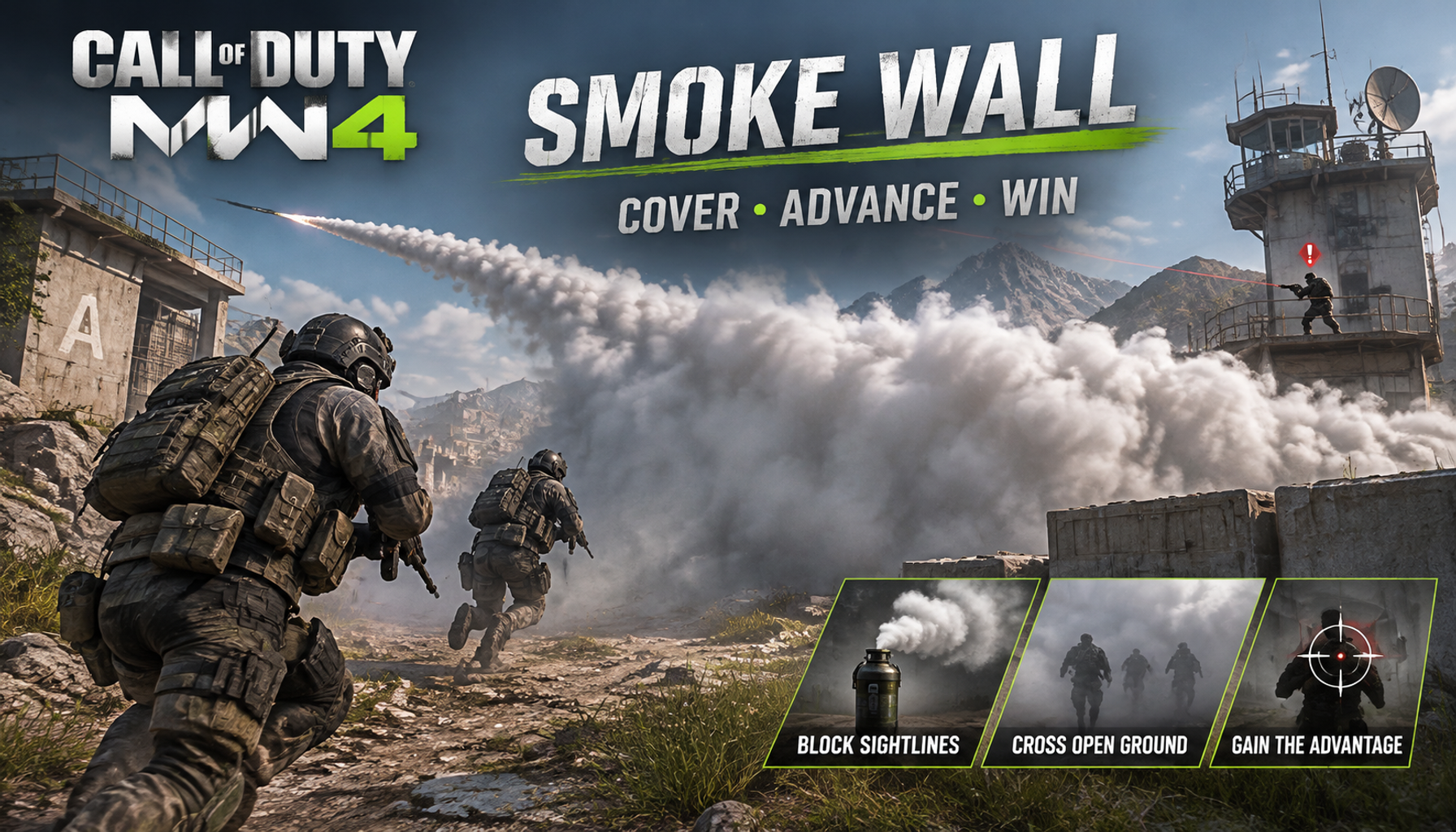
Crossing an open stretch of ground can quickly become one of the most dangerous decisions in Call of Duty multiplayer. Defenders holding long sightlines have time to track approaching players, adjust their aim, and punish anyone caught between pieces of cover. Traditional smoke grenades can interrupt that view, but a single cloud does not always provide enough coverage for a coordinated advance. Smoke Wall offers a different approach by launching a rocket that leaves a continuous trail of smoke along its route. This gives attacking teams another way to approach exposed areas, particularly when they need to break away from predictable movement patterns. Players who spend time refining their map awareness and movement in CoD MW4 Boosting can also benefit from understanding how visibility influences an engagement, since choosing when and where to cross an exposed lane can matter as much as winning the resulting gunfight.
Smoke Wall Changes the Way Players Approach Open Ground
The defining feature of Smoke Wall is its deployment pattern. Instead of producing a single cloud around the point where a grenade lands, it launches a rocket that leaves dense smoke along its path. The resulting barrier can obscure a longer stretch of ground and interfere with the sightlines defenders use to monitor approaching enemies.
This is particularly relevant on maps where buildings, walls, and other natural cover are separated by wide gaps. A player moving between two protected positions may have to cross an area watched by several opponents, leaving few opportunities to move without being noticed. A conventional smoke grenade can hide part of that journey, but the remaining distance may still leave players exposed. Smoke Wall addresses this problem by creating a more connected area of concealment along the route.
The effect also changes how defenders respond to an approaching team. A player holding a distant firing position may lose a clear view of the lane and need to find another angle or wait for visibility to return. That interruption can create a useful opening for attackers, especially when the original defensive position depends on seeing enemies before they reach nearby cover.
However, the smoke does not eliminate the importance of map awareness. Players still need to understand where opponents are likely to be positioned and which areas remain dangerous once they leave the covered route.
Three Battlefield Situations Where Smoke Wall Can Make a Difference
Smoke Wall has the clearest tactical value when the team needs to overcome a specific visibility problem. Wide outdoor lanes, exposed objective approaches, and locations with limited alternative routes all create situations where a moving smoke barrier can support a more deliberate advance.
| Battlefield situation | Tactical advantage | Key consideration |
|---|---|---|
| Crossing open ground | Interrupts distant sightlines during movement | Coordinate the crossing with the smoke deployment |
| Approaching an objective | Makes the attacking route harder to monitor | Account for defenders already positioned near the objective |
| Changing firing positions | Creates an opportunity to leave an exposed location | Identify the next position before moving |
Open lanes present the most straightforward application. When an enemy team controls a long stretch of ground, repeatedly attempting to cross it can lead to predictable engagements. Smoke Wall can disrupt that pattern, giving players an opportunity to move toward nearby cover without following the same exposed route every time.
Objective approaches require more careful coordination. Defenders often watch the entrances and surrounding lanes leading toward a capture point, making it difficult for attackers to approach without being spotted. A smoke trail can interrupt those views, but the attacking team still needs to consider enemies holding the objective itself. The most useful approach is to treat the smoke as a way to reach a better position, not as a reason to rush directly into a contested area.
Repositioning offers another practical application. A player who has been holding the same firing angle for an extended period may become easier to anticipate. Smoke Wall can help obscure a change of position, allowing that player to leave the exposed area and establish a new angle before opponents can fully adjust.
How Smoke Wall Differs From Traditional Smoke Grenades
Although both tools interfere with enemy visibility, their deployment patterns serve different purposes. Traditional smoke grenades are generally more convenient when a player needs to obscure a specific location. They can block a doorway, cover a small section of an objective, or provide temporary concealment during a close-range encounter.
Smoke Wall focuses on movement across a longer route. Its forward-moving rocket leaves a trail of smoke that can interfere with sightlines between distant positions. This makes it more relevant when several players need to cross an exposed area rather than remain concealed around one particular location.
The practical differences are straightforward:
- Smoke grenades provide localized concealment, making them useful for covering a particular position or entrance.
- Smoke Wall creates a forward-moving smoke trail that can obstruct longer sightlines.
- Traditional smoke is generally more convenient for immediate concealment in confined spaces.
- Smoke Wall offers another option when a team needs to move through a longer exposed route.
Neither option is automatically superior. A player defending a narrow entrance may gain more from a conventional smoke grenade, while a squad attempting to cross a wide outdoor lane may find Smoke Wall more suitable. The map layout, available cover, and distance between positions should determine which option makes more sense.
Smoke Wall Can Change the Timing of Aggressive Engagements
Aggressive players often look for opportunities to close the distance before defenders can establish a comfortable firing position. An exposed approach, however, can reveal their movement long before they reach an effective engagement range. Smoke Wall gives them another way to challenge that defensive advantage, particularly when the team has a clear plan for what happens after deployment.
Consider a squad approaching an objective from a position watched by opponents at a distance. If the attacking players simply run forward, defenders can focus their fire on the exposed route. Deploying Smoke Wall before the advance can interrupt that view and create an opportunity for the squad to move closer. Players who reach nearby cover can then prepare to challenge the defenders from a more favorable distance, rather than continuing to cross the same open lane.
The timing of that movement is important. Activating the equipment too early may give opponents time to recognize the incoming push and prepare alternative firing angles. Waiting until teammates have already started crossing can leave part of the squad exposed. A coordinated deployment allows players to use the same temporary opening instead of moving forward at different times.
Defenders also have decisions to make. Some may hold their positions and wait for the smoke to clear, while others may move to a different angle or use available equipment to disrupt the coverage. Attackers should account for these reactions instead of assuming that every opponent will remain in place.
For players studying MW4 Smoke Wall tactics, the important question is not simply when to deploy the equipment, but what advantage the team intends to gain from it. A successful advance might involve reaching a new piece of cover, creating pressure on a defensive position, or forcing opponents to abandon a useful firing angle. Having that objective in mind makes the deployment part of a larger tactical decision rather than an isolated action.
Smoke Wall Has Limitations That Can Affect Its Effectiveness
Smoke Wall can disrupt enemy visibility, but it does not create an impenetrable barrier. Its smoke can be affected by gunfire and dispersed by explosives, giving opponents ways to interfere with the coverage. A team that depends entirely on the smoke remaining intact may find its advance interrupted when defenders respond.
Reduced visibility can also create problems for the attacking side. Players moving through dense smoke may struggle to identify nearby enemies, obstacles, or the safest direction to continue. An opponent positioned near the end of the covered route may still create a dangerous close-range encounter, even if distant defenders have temporarily lost their view.
Several factors deserve attention before deployment:
- Check the main enemy sightlines and identify the area that needs concealment.
- Make sure teammates are ready to move when the smoke is deployed.
- Avoid relying on one route when the surrounding map offers alternative approaches.
- Watch for explosives and gunfire that can disrupt the smoke.
- Prepare for enemies positioned beyond the covered area rather than assuming the route is clear.
These limitations are especially important when attacking teams have little room to change direction. If the smoke disappears before players reach the next protected position, they may have to complete the crossing under the same pressure they were trying to avoid. Smoke Wall therefore works best when the team has already considered its next move and is not relying on concealment alone to carry the engagement.
Team Coordination Will Shape Smoke Wall’s Role in MW4
Smoke Wall introduces another way for teams to influence the information available to their opponents. Defenders often gain an advantage by recognizing where attackers are moving and preparing their aim before an engagement begins. When that visual information becomes less reliable, they may have to make decisions without knowing exactly how many players are advancing or which route they intend to take.
This creates an interesting tactical choice for both sides. Attackers can use the smoke to change their approach, while defenders must decide whether to maintain their current positions or move to recover a clear view. A team that reacts too slowly may give up valuable ground, but one that abandons its position immediately could leave an important area vulnerable.
The equipment is therefore more than a temporary solution to exposed movement. It introduces another factor into how teams manage space and information during a match. Its usefulness will vary with the map layout and the availability of alternative routes, but it gives players another option when conventional approaches become too predictable.
Smoke Wall will not replace good positioning or accurate shooting, and its limitations mean that deployment alone cannot decide an engagement. Its greater significance lies in the decisions it forces both teams to make. As players continue improving their movement, map awareness, and coordination in MW4 Bot Lobbies, understanding how to use temporary visual cover can provide a clearer picture of the tactical choices that shape multiplayer matches.